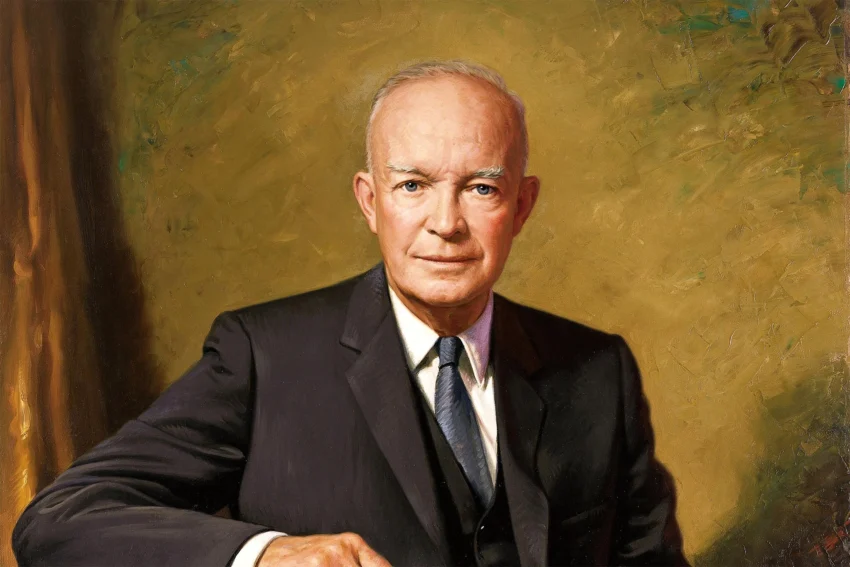
Dwight D. Eisenhower was an American military commander and statesman who rose from a modest Kansas upbringing to become Supreme Allied Commander during World War II and later the 34th President of the United States.
Known affectionately as “Ike,” Eisenhower led the D-Day invasion of Normandy and later guided the nation through a period of Cold War tension and domestic prosperity.
This biography covers his early life, education, military career, presidency, and lasting legacy.
Profile
| Full Name | Dwight David Eisenhower |
| Born | October 14, 1890 |
| Died | March 28, 1969 (aged 78) |
| Birthplace | Denison, Texas, United States |
| Place of Death | Washington, D.C., United States |
| Nationality | American |
| Occupation | General of the Army, 34th President of the United States, Academic Administrator |
| Political Party | Republican |
| Religion | Raised Mennonite; later Presbyterian |
| Education | United States Military Academy, West Point (graduated 1915) |
| Parents | Father – David Jacob Eisenhower; Mother – Ida Elizabeth Stover Eisenhower |
| Siblings | Third of seven sons |
| Spouse | Mamie Geneva Doud (married 1916) |
| Children | Two sons – Doud Dwight (died in childhood) and John Eisenhower |
| Known For | Supreme Allied Commander in WWII; D-Day invasion; 34th U.S. President (1953–1961) |
Early Life
Dwight David Eisenhower was born on October 14, 1890, in a house by the railroad tracks in Denison, Texas, to David Jacob Eisenhower and Ida Elizabeth Stover Eisenhower.
He was the third of seven sons. Shortly after his birth, the family moved to a small farm in Abilene, Kansas, where Eisenhower spent most of his childhood.
His father worked as a mechanic in a local creamery, while his mother, a devout Mennonite, was a committed religious pacifist who opposed war.
Growing up, young “Ike” took part in family chores and developed a passion for hunting, fishing, and football, alongside an early fascination with military history.
Education
To his mother’s distress given her pacifist beliefs, Eisenhower won an appointment to the United States Military Academy at West Point, New York, entering in June 1911.
At West Point, he was popular and gregarious, though not considered a particularly dedicated student, and was known for his pranks, fondness for cards, and average grades.
He played football until a serious knee injury, sustained in a game against Jim Thorpe’s Carlisle Indians, ended his playing career; he subsequently coached the academy’s freshman team.
Despite predictions from some superiors that he was “born to command,” he graduated in the middle of his class, 61st out of 164 cadets, in 1915.
Career
After graduating from West Point, Eisenhower was stationed at Fort Sam Houston, Texas, where he met Mary Geneva “Mamie” Doud, a vivacious socialite. The couple married in 1916 and had two sons, Doud Dwight, who died of scarlet fever as a young child, and John Eisenhower. Frustrated by missing combat in World War I, Eisenhower nonetheless excelled in staff assignments over the following decades, serving under prominent generals including John J. Pershing and Douglas MacArthur, and gaining an appointment to the Command and General Staff College.
Following the outbreak of World War II in Europe in 1939, Eisenhower returned to active planning duty in the United States, where his leadership during large-scale Third Army field maneuvers in Louisiana, involving more than 400,000 troops, showcased his strategic talent and earned him a promotion to brigadier general. Days after the attack on Pearl Harbor, he was called to Washington, D.C., to help develop U.S. war plans, quickly impressing Army Chief of Staff George C. Marshall and earning rapid promotions and increasingly critical assignments.
Eisenhower rose to become Supreme Commander of the Allied Expeditionary Force in Europe, orchestrating the historic D-Day landings at Normandy, France, on June 6, 1944, a turning point in the Allied campaign against Nazi Germany. At the Potsdam Conference in July 1945, Eisenhower notably opposed the use of atomic bombs against Japan, arguing the country was already close to surrender and that using such a devastating new weapon would damage America’s international standing. He returned home to a hero’s welcome in 1945.
Later that year, President Harry Truman named Eisenhower to succeed Marshall as Army Chief of Staff, a role in which he oversaw demobilization of the wartime military and worked to unify the armed services under centralized command for more than two years. In May 1948, he left active duty to become president of Columbia University in New York City, though his academic administration tenure was considered less successful than his military career. That same year, his memoir Crusade in Europe was published, becoming a bestseller and making him a wealthy man. In 1951, he took leave from Columbia to assume supreme command of the newly formed NATO forces in Europe.
Persuaded by Republican emissaries who traveled to his headquarters near Paris, Eisenhower agreed to run for President of the United States in 1952. Campaigning under the popular slogan “I like Ike,” he won a sweeping victory over Illinois Governor Adlai Stevenson and was inaugurated as the 34th President in 1953, serving two terms until 1961.
As president, Eisenhower negotiated an armistice ending the Korean War in 1953 and worked to reduce Cold War tensions with the Soviet Union, including a landmark 1955 summit in Geneva with British, French, and Soviet leaders following the death of Joseph Stalin. He authorized covert anti-communist CIA operations around the world and maneuvered behind the scenes to discredit Senator Joseph McCarthy’s anti-communist campaign. On the domestic front, Eisenhower strengthened Social Security, launched the Interstate Highway System, and inaugurated the U.S. space program. His administration has also drawn historical criticism for its limited enforcement of the Supreme Court’s 1954 Brown v. Board of Education desegregation mandate.
Awards & Honors
- Five-Star General of the Army
- Supreme Allied Commander, European Theater, World War II
- Numerous U.S. and international military honors for his role in Allied victory in WWII
- Widely regarded historically as one of the most effective U.S. presidents of the 20th century
Personal Life
Dwight Eisenhower married Mamie Geneva Doud in 1916, and the couple remained married until his death, sharing more than five decades together.
They had two sons: Doud Dwight, who tragically died in childhood from scarlet fever, and John Eisenhower, who went on to have his own distinguished military and diplomatic career.
After leaving the presidency in 1961, the Eisenhowers retired to a farm in Gettysburg, Pennsylvania, the only home they ever owned. Eisenhower passed away on March 28, 1969, in Washington, D.C., at the age of 78.
Net Worth & Legacy
Eisenhower’s wealth grew substantially following the 1948 publication of his bestselling war memoir, Crusade in Europe.
His legacy today is defined by his roles as one of the architects of Allied victory in World War II and as a president who guided the United States through a critical period of Cold War tension and domestic transformation, including the creation of the national highway system that remains in use today.
FAQs
Who was Dwight D. Eisenhower?
Dwight D. Eisenhower was an American general who served as Supreme Allied Commander during World War II and later became the 34th President of the United States.
What is Eisenhower best known for?
He is best known for commanding the D-Day invasion of Normandy in 1944 and for his two terms as U.S. president from 1953 to 1961.
Where did Eisenhower grow up?
Although born in Denison, Texas, Eisenhower spent most of his childhood in Abilene, Kansas.
Did Eisenhower attend West Point?
Yes, he graduated from the United States Military Academy at West Point in 1915.
When did Eisenhower die?
He passed away on March 28, 1969, in Washington, D.C., at the age of 78.
Conclusion
From a modest upbringing on a Kansas farm to commanding the largest amphibious invasion in history and ultimately leading the United States as president, Dwight D. Eisenhower’s life reflects a rare combination of military brilliance and steady political leadership.
His legacy endures through the Interstate Highway System, his role in shaping Cold War-era foreign policy, and his enduring reputation as one of America’s most respected 20th-century leaders.