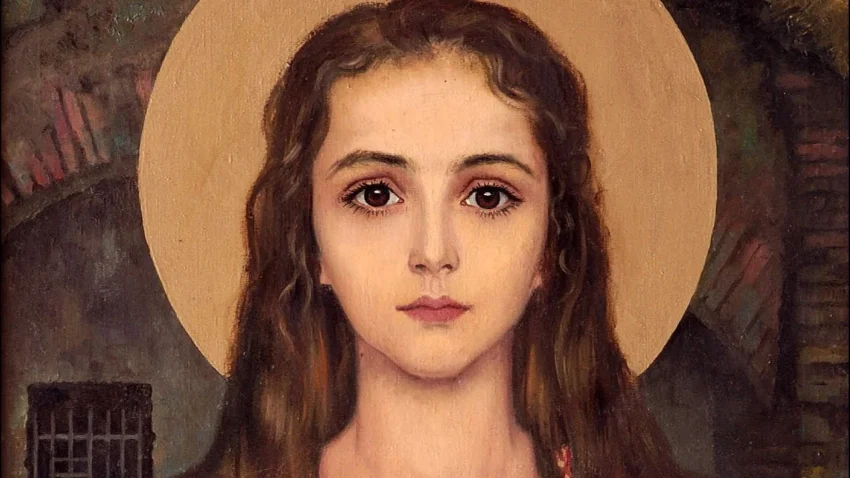
Saint Philomena is one of the most beloved and devotionally significant figures in Catholic tradition.
Known widely as the “Wonder Worker” and celebrated for the extraordinary miracles attributed to her intercession, she is venerated as a virgin martyr of the early Christian Church who died around 304 AD rather than surrender her vow of consecrated virginity to the Roman Emperor Diocletian.
Though her historical existence remains a matter of scholarly discussion and her feast was removed from the official Roman Missal in 1961 devotion to her continues to thrive among Catholics worldwide, particularly in Italy, India, Ireland, and Latin America, where she is revered as a powerful intercessor for children, youth, and those in desperate need.
Profile Details
| Full Name | Philomena (also spelled Filumena) |
| Born | c. January 10, 291 AD, Greece |
| Died | c. August 10, 304 AD, Rome, Italy (aged c. 13) |
| Nationality | Greek |
| Religion | Early Christian (Catholic martyr) |
| Parents | A Greek king and queen who converted to Christianity (according to tradition) |
| Feast Day | August 11 (Catholic Church); August 10 / 4 Misra (Coptic Orthodoxy) |
| Major Shrine | Sanctuary of Saint Philomena, Mugnano del Cardinale, Italy |
| Patronage | Infants, babies, youth, the Living Rosary Association |
| Venerated in | Catholic Church, Oriental Orthodoxy |
| Attributes | Martyr’s palm, crown of white and red roses, arrows, anchor |
Early Life and Origins
According to Catholic tradition, primarily derived from the reported visions of Sister Maria Luisa di Gesù a Dominican tertiary nun from Naples who claimed in 1833 that Saint Philomena appeared to her Philomena was born around January 10, 291 AD, in Greece. She was the daughter of a Greek king who, along with his wife and household, had converted to Christianity during the reign of Emperor Diocletian.
The name Philomena is derived from the Greek words meaning “loved” or “friend of light,” a name that tradition associates with her luminous virtue and beloved status among early Christians. From an early age, Philomena was described as deeply devout and spiritually precocious. At the age of thirteen, she reportedly took a formal vow of consecrated virginity, dedicating her life and purity entirely to Jesus Christ.
Around the year 303–304 AD, her father, seeking to make peace with Rome, brought his family to the Imperial court. It was there that the teenage Philomena caught the attention of Emperor Diocletian one of the most notorious persecutors of early Christians in Roman history. According to tradition, Diocletian became enamored with the young princess and sought her hand in marriage. Philomena firmly refused, citing her vow of virginity and her dedication to Christ.
Martyrdom
Her refusal of the Emperor’s marriage proposal set in motion a series of terrible tortures, each designed to break her will and force her to renounce both her faith and her vow. According to the traditional account, Philomena endured the following ordeals:
First, she was ordered to be scourged severely. According to tradition, angels appeared and healed her wounds overnight, leaving her persecutors astonished.
Second, she was bound to an anchor and thrown into the Tiber River to drown. She was said to have been miraculously saved and brought to shore by angels.
Third, she was subjected to a barrage of arrows. The arrows reportedly turned back in midair or fell harmlessly, again frustrating her executioners.
Finally, after all these attempts on her life failed, Diocletian ordered that she be beheaded. Philomena died around August 10, 304 AD, at approximately 13 years of age offering her life completely to Christ rather than compromise her faith or her vow of virginity. The Church regards her death as the supreme act of a virgin martyr.
It is important to note that the Church has never officially verified these accounts as historical. The Holy Office declared in 1833 that there was nothing contrary to the Catholic faith in Sister Maria Luisa’s revelations, but this declaration is distinct from canonical verification of the events described.
Discovery of the Tomb
Philomena’s story largely receded from Christian memory for over fifteen centuries. Then, in May 1802, workers excavating within the Catacomb of Priscilla on the Via Salaria Nova in Rome discovered a sealed tomb. Three painted tiles bore the inscription in Latin: PAX TECUM FILUMENA — “Peace be with you, Philomena.” Inside the tomb, archaeologists found the skeletal remains of a young woman, along with a vial that contained what appeared to be dried blood a traditional symbol that the deceased was a martyr.
The symbols on the tiles two anchors, three arrows, a palm branch (symbol of martyrdom), and a lily were interpreted as emblems of Philomena’s reported suffering and virtue. Scientists of the time determined that the remains belonged to a young woman of around 13–15 years of age.
In 1805, Canon Francesco De Lucia of Mugnano del Cardinale, a small town near Naples, was granted permission to take Philomena’s relics. He had them enshrined in the Church of Our Lady of Grace in Mugnano. Almost immediately, a remarkable series of healings and miraculous events were reported at the shrine, drawing pilgrims from across southern Italy and beyond.
Miracles and Devotion
The miraculous reputation of Saint Philomena grew rapidly in the 19th century. Among the most celebrated events attributed to her intercession was the healing of Venerable Pauline Jaricot, founder of the Association for the Propagation of the Faith, who was reportedly cured of a severe cardiac condition in 1835 after visiting Mugnano’s shrine. The healing received wide publicity and was examined by Pope Gregory XVI.
Pope Gregory XVI himself became a devoted champion of Saint Philomena, calling her the “Great Wonder Worker of the 19th Century” in 1837, further spreading her cult throughout the Catholic world. Saint John Vianney the beloved Curé of Ars and himself a canonized saint was one of Philomena’s most famous devotees. He attributed numerous conversions and miraculous healings in his parish at Ars to her intercession, and reportedly stated: “Whatever you ask from Saint Philomena, she will obtain for you.”
Several other celebrated saints are said to have held deep devotion to Philomena, including Saint Peter Julian Eymard and Venerable Francis Xavier Seelos.
Removal from the Roman Calendar
Despite the widespread popular devotion to Saint Philomena, the Church’s scholarly review of her case raised significant concerns. In 1961, during the liturgical reforms initiated by Pope John XXIII, Saint Philomena’s feast day was removed from the Roman Missal and her name from the Roman Martyrology. This decision was based primarily on the following factors: the lack of verifiable historical evidence for her existence outside of private revelations; the fact that the symbols on her tomb tiles were now interpreted by archaeologists as common decorative motifs rather than symbols specific to her martyrdom; and the discovery that the tiles sealing her tomb appeared to have been arranged from different tombs, possibly not original to her burial.
Crucially, her removal from the official calendar does not constitute a declaration that she did not exist or was not a martyr. The Church simply lacks the historical documentation necessary to include her in the official liturgy. Private and regional devotion to Saint Philomena remains permitted and widespread.
Legacy and Continued Veneration
Today, the Sanctuary of Saint Philomena in Mugnano del Cardinale, Italy, remains a major pilgrimage site, drawing thousands of faithful annually. She is the patroness of infants, babies, and youth, and is invoked by parents for the protection of their children. The Living Rosary Association, founded by Pauline Jaricot, was placed under her patronage. Numerous parishes, schools, and hospitals across the world bear her name. In India, particularly in the state of Karnataka, the St. Philomena’s Cathedral in Mysore is one of the most architecturally grand churches in Asia and a celebrated pilgrimage destination.
Personal Life (Historical Note)
As a figure of early Christian antiquity, Saint Philomena has no documented personal biography in the conventional sense. What is known or rather, traditionally recounted is that she was a young Greek princess who placed her faith and her vow of virginity above earthly comfort, royal privilege, and life itself. Her steadfastness in the face of torture and death has made her a symbol of purity, courage, and unwavering faith for millions of Catholics worldwide. She is typically depicted in Catholic iconography holding a palm branch (signifying martyrdom), an anchor (symbolizing her reported ordeal in the Tiber), and arrows (referencing the reported attempt on her life by archers).
FAQs About St. Philomena
Q: Who is Saint Philomena?
A: Saint Philomena is a Catholic virgin martyr believed to have been a Greek princess who was executed around 304 AD for refusing to renounce her Christian faith and vow of chastity before Emperor Diocletian.
Q: When was Saint Philomena’s tomb discovered?
A: Her tomb was discovered in May 1802 in the Catacomb of Priscilla in Rome.
Q: Why was Saint Philomena removed from the Roman Calendar?
A: She was removed in 1961 by Pope John XXIII due to insufficient historical evidence of her existence and the inability to verify her canonization through the Church’s standard process.
Q: Is devotion to Saint Philomena still allowed?
A: Yes. While she is not on the official Roman Calendar, private devotion to Saint Philomena remains fully permitted and is encouraged by many faithful Catholics.
Q: What is Saint Philomena the patron saint of?
A: She is the patron saint of infants, babies, and youth.
Q: Who was Saint John Vianney’s favorite saint?
A: Saint John Vianney was one of the most devoted promoters of Saint Philomena, frequently attributing miraculous healings and conversions in his parish to her intercession.
Conclusion
Saint Philomena’s story is one of the most fascinating and contested in the history of the Catholic Church. Whether viewed through the lens of historical scholarship or personal faith, her story speaks to something deeply universal: the willingness of a young soul to give everything for love of God. The miracles attributed to her intercession, the devotion of great saints to her cause, and the enduring pilgrimage to her shrine in Mugnano all testify to the extraordinary spiritual energy surrounding her name. Whether she lived exactly as tradition describes is a matter for historians; that she continues to move the hearts of the faithful is beyond question. Saint Philomena, Wonder Worker and Virgin Martyr pure in faith, fierce in love, eternal in prayer.