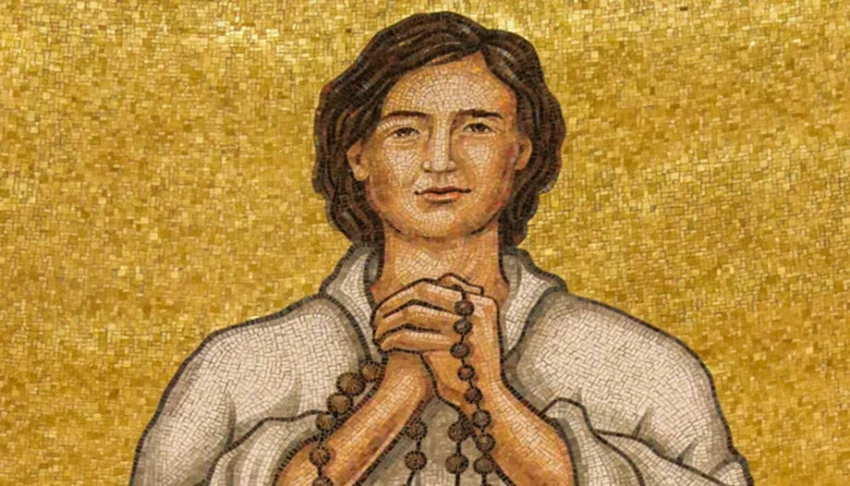
San Lorenzo Ruiz is one of the most revered figures in Philippine Catholic history.
Known as the first Filipino saint, he was a devoted family man, a calligrapher, and a lay member of the Confraternity of the Most Holy Rosary who ultimately gave his life for his Christian faith in 17th-century Japan. His story of courage, faith, and martyrdom continues to inspire millions of Filipino Catholics around the world.
He was canonized by Pope John Paul II on October 18, 1987, in Rome, making him the first Filipino to be officially declared a saint by the Catholic Church.
Profile Details
| Full Name | Lorenzo Ruiz y de la Cruz (San Lorenzo Ruiz de Manila) |
| Born | c. 1594–1600 |
| Birthplace | Binondo, Manila, Philippines |
| Nationality | Filipino |
| Occupation | Calligrapher, Lay Catholic, Martyr, Saint |
| Religion | Roman Catholic |
| Parents | Chinese father, Filipino mother (both Christian) |
| Spouse | Rosario (Filipino wife) |
| Children | Three (two sons and one daughter) |
| Died | September 29, 1637, Nagasaki, Japan |
| Feast Day | September 28 (Philippines); September 26 (General Roman Calendar) |
| Canonized | October 18, 1987, by Pope John Paul II |
Early Life
San Lorenzo Ruiz was born around 1594 to 1600 in Binondo, Manila, in what was then the Spanish colonial Philippines. His father was Chinese and his mother was Filipino, and both were devoted Christians. Growing up in a bilingual and bicultural household, Lorenzo learned Chinese from his father and Tagalog from his mother. He also learned Spanish through his close association with the Dominican friars of the Binondo Parish.
From an early age, Lorenzo demonstrated deep religious devotion. He served as an altar boy at the historic Binondo Church, which is still regarded as the world’s oldest Chinatown church. His early education was provided by the Dominican friars, who recognized his intelligence and dedication. He excelled particularly in calligraphy and penmanship, skills that would later earn him a professional title.
Lorenzo grew up in Binondo, a predominantly Chinese Christian community in Manila. His childhood was shaped by the vibrant faith life of his parish and the cultural richness of his mixed heritage a heritage that made him uniquely Filipino and uniquely Asian.
Education
Lorenzo Ruiz received his basic education from the Dominican friars who operated schools within the Binondo Parish community. Under their tutelage, he became highly proficient in reading and writing in Tagalog, Chinese, and Spanish. He also gained enough knowledge in Latin, owing to his service as an altar boy and sacristan. His educational formation was deeply religious in character, centered on Catholic doctrine and practice. After his studies, he earned the distinguished title of escribano (calligrapher or notary), a recognition of his exceptional penmanship and literacy a rare and prized skill in 17th-century colonial Philippines.
Career
Lorenzo Ruiz built a respectable and peaceful life as a professional calligrapher in Binondo. He served as a clerk for the Binondo Church, transcribing official documents with his skilled hand. This was a valued occupation, as written records of land titles, legal agreements, and ecclesiastical documents were essential to colonial administration.
Beyond his professional work, Lorenzo was an active and devout lay member of the Cofradia del Santísimo Rosario (Confraternity of the Most Holy Rosary), a religious organization under Dominican auspices. He was known as a faithful Mass-goer, a devotee of the Virgin Mary, and among the select few who were encouraged to receive Holy Communion every first Sunday of the month a mark of exceptional piety for his time.
His ordinary life was shattered in 1636 when he was falsely accused of killing a Spaniard. Fearing execution, Lorenzo sought refuge with three Dominican priests Saint Antonio Gonzalez, Saint Guillermo Courtet, and Saint Miguel de Aozaraza as well as a Japanese priest, Saint Vicente Shiwozuka de la Cruz, and a lay leper, Saint Lazaro of Kyoto. Together, they boarded a ship and sailed for Okinawa on June 10, 1636.
Upon arrival in Japan, the group was immediately arrested by the authorities during a period of intense persecution of Christians under the Tokugawa Shogunate. After being imprisoned for two years, they were transferred to Nagasaki in 1637 to face trial by torture. The missionaries and Lorenzo endured horrific physical tortures intended to force them to renounce their Christian faith. These included having water forced down their throats before their abdomens were pressed to expel it violently, as well as bodily piercing and cutting.
Lorenzo remained steadfast. When given the chance to apostatize and save his life, he reportedly declared: “I am a Christian, and I shall die for God, and for Him I will give many thousands of lives if I had them. And so I cannot do this, because I am a Christian. And so I will die for God.” He was subjected to the tsurushi — a form of torture in which a person is hung upside down in a pit, with the head partially submerged, until death occurs from slow suffocation and blood loss. He died on September 29, 1637.
His body, along with those of his companions, was cremated and the ashes thrown into the sea to prevent the relics from being venerated.
Beatification and Canonization
The cause for the beatification of Lorenzo Ruiz and his companions was championed by the noted Filipino Dominican historian Fr. Fidel Villarroel, O.P. In February 1981, during Pope John Paul II’s historic papal visit to the Philippines, Lorenzo Ruiz and his companions were beatified a ceremony held outside the Vatican for the first time in history, making it a landmark event in global Catholicism.
On October 18, 1987, Pope John Paul II canonized Lorenzo Ruiz in Rome, officially declaring him a saint and making him the first Filipino saint in the history of the Catholic Church. The canonization was confirmed by a miracle that occurred in 1983: a two-year-old girl, Cecilia Alegria Policarpio, suffering from congenital brain atrophy, was reportedly cured after her family and supporters prayed to Ruiz for intercession.
Pope John Paul II described Lorenzo as “the most improbable of saints,” highlighting that his sainthood grew not out of a religious vocation but from the ordinary life of a layman a husband, a father, and a working man who chose God over his own life.
Legacy and Veneration
San Lorenzo Ruiz is the patron saint of the Philippines and of Filipino migrants worldwide. His feast day is celebrated on September 28 in the Philippines and September 26 on the General Roman Calendar. Numerous churches, schools, and community centers around the world are named in his honor, including the San Lorenzo Ruiz de Manila Community Center in Sugar Land, Texas, USA.
A mosaic of St. Lorenzo is featured in the Trinity Dome of the Basilica of the National Shrine of the Immaculate Conception in Washington, D.C. He is also depicted in American artist John Nava’s Communion of Saints tapestries hanging in the Cathedral of Our Lady of the Angels in Los Angeles, California.
In the Philippines, a 1970 biographical film Ang Buhay ni Lorenzo Ruiz and a 1988 documentary Lorenzo Ruiz… The Saint… A Filipino! were produced in his honor. The Minor Basilica and National Shrine of St. Lorenzo Ruiz in Binondo, Manila, stands as the primary site of his veneration in his homeland.
Personal Life
Before his martyrdom, Lorenzo Ruiz led a quietly fulfilling domestic life. He was married to a Filipino woman named Rosario, and together they had three children two sons and a daughter. By all historical accounts, the Ruiz family led a peaceful, contented, and deeply Christian life. Lorenzo was devoted to his wife and children, fulfilling his obligations as a husband and father with sincerity. It was this ordinary, grounded life far removed from ecclesiastical or heroic ambitions that made his eventual martyrdom all the more remarkable in the eyes of the Church.
FAQs About San Lorenzo Ruiz
Q: Who is San Lorenzo Ruiz?
A: San Lorenzo Ruiz is the first Filipino saint of the Catholic Church, a 17th-century lay calligrapher and martyr who was canonized by Pope John Paul II in 1987.
Q: When was San Lorenzo Ruiz canonized?
A: He was canonized on October 18, 1987, in Rome by Pope John Paul II.
Q: Where did San Lorenzo Ruiz die?
A: He died in Nagasaki, Japan, on September 29, 1637, as a result of torture inflicted for refusing to renounce his Christian faith.
Q: What is San Lorenzo Ruiz the patron saint of?
A: He is the patron saint of the Philippines and of Filipino migrant workers overseas.
Q: What language did San Lorenzo Ruiz speak?
A: He spoke Tagalog, Chinese, and Spanish, as taught by his Filipino mother, Chinese father, and Dominican friars respectively.
Q: Why is San Lorenzo Ruiz considered significant?
A: He is significant as the first Filipino to be canonized a saint, and as a symbol of lay Catholic devotion and the courage of ordinary people of faith.
Conclusion
San Lorenzo Ruiz’s biography is a testimony to the power of ordinary faith elevated by extraordinary courage. He was not a priest, a bishop, or a theologian he was a husband, a father, a calligrapher, and a devoted lay Catholic who chose death over apostasy. His story remains a source of immense pride for the Filipino nation and a beacon of inspiration for Catholics worldwide. As the first Filipino saint, San Lorenzo Ruiz permanently inscribed the Philippines’ name in the universal history of the Catholic Church. His legacy lives on not only in the churches and shrines dedicated to him but in every Filipino who finds courage in faith.