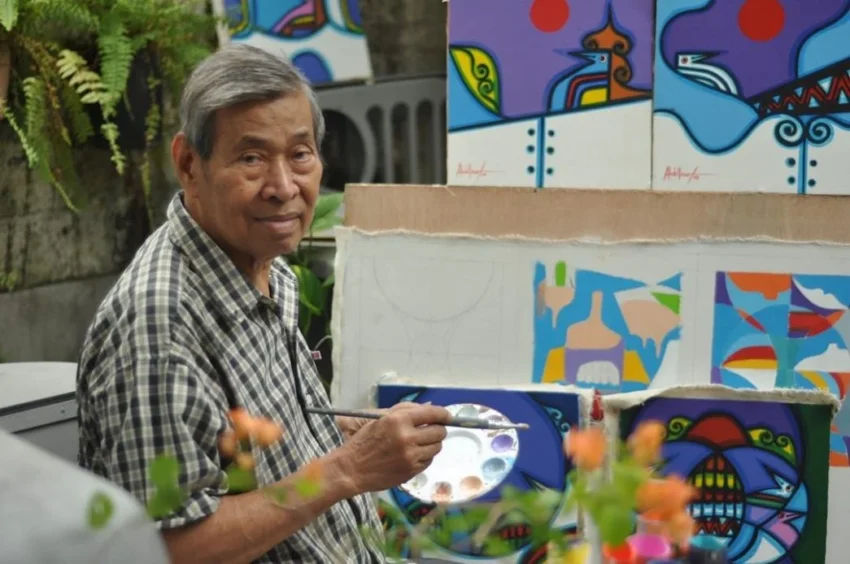
Abdulmari Asia Imao is one of the most remarkable and historically significant figures in the history of Philippine art.
A Tausūg sculptor, painter, photographer, ceramist, filmmaker, cultural researcher, and writer from Siasi, Sulu, he is best known as the first Moro and the first person from Mindanao to be named a National Artist of the Philippines, the country’s highest honor for artistic achievement.
Named National Artist for Visual Arts in 2006, Imao spent his life bridging the cultural divide between Christian and Muslim Philippines, using art as his medium and the mythic imagery of southern Philippine culture the sarimanok, the okir/ukkil, the naga as his language.
His legacy is not simply that of a great artist; it is the legacy of a man who gave the Bangsamoro people a visible, beautiful, and nationally recognized artistic identity.
Profile Details
| Full Name | Abdulmari Asia Imao |
| Born | January 14, 1936 |
| Birthplace | Siasi, Sulu, Philippines |
| State of Origin | Sulu, Bangsamoro Autonomous Region |
| Nationality | Filipino |
| Occupation | Sculptor, Painter, Photographer, Ceramist, Filmmaker, Cultural Researcher, Writer |
| Religion | Islam |
| Spouse | Grace Bondoc de Leon (deceased) |
| Children | 4 sons: Abdulmari Jr. (Toym), Josemari, Juan Sajid, AlKarim |
| Died | December 16, 2014, Marikina City, Philippines (aged 78) |
| National Artist Award | National Artist for Visual Arts, 2006 |
Early Life
Abdulmari Asia Imao was born on January 14, 1936, in the small island town of Siasi in the province of Sulu, in the Sulu Archipelago of the southern Philippines. He was born into a Tausūg family one of the major ethno-linguistic groups of Mindanao and Sulu, known for their warrior tradition, their seafaring culture, and their deep Islamic faith. His family name, Imao, is said to be a shortened form of the Tausūg word halimaw, which historically referred to their ancestral role as warriors particularly in resistance against colonial forces during the American and Japanese occupations.
Growing up in Siasi, a fishing community surrounded by the sea, Abdulmari spent his boyhood watching fishermen haul their daily catch. He became captivated by the extraordinary colors of the fish blue, green, yellow, pink, purple, and orange a childhood memory that would later become a defining palette of his mature paintings. The vivid colors of the sea and its creatures, together with the intricate geometric patterns of Tausūg and Maranao decorative art that surrounded him in daily life, formed the visual vocabulary that would eventually define his artistic identity.
Despite his family’s modest circumstances and against all the odds of geography, culture, and political circumstance that separated the Muslim south from the predominantly Christian center of Philippine national life Abdulmari Imao nurtured an intense passion for visual art and an indomitable determination to pursue it.
Education
Imao completed his high school education in Sulu in 1956. That same year, a pivotal encounter changed the course of his life. The Philippine Navy was running a floating exhibition called LST (Landing Ship, Tank), which carried works by distinguished Filipino artists including Fernando Amorsolo, Carlos “Botong” Francisco, and Vicente Manansala. When the exhibition arrived in Sulu, Imao conversed with Tomas Bernardo the exhibition’s curator about painting, and showed Bernardo samples of his own work. Impressed, Bernardo took Imao to Manila.
In Manila, Imao wrote directly to President Ramon Magsaysay seeking a study grant. Through the assistance of Jose Maria Ansaldo, an aide to the President, Imao was enrolled as a pensionado of the Commission on National Integration at the University of the Philippines Diliman. There, he studied under two of the Philippines’ greatest artists, both of whom preceded him as National Artists: Guillermo Tolentino (sculptor) and Napoleon Abueva. Imao graduated with a Bachelor of Fine Arts in Sculpture from UP in 1959.
His education did not stop in Manila. As a Smith-Mundt and Fulbright Scholar, he pursued graduate studies at the University of Kansas in the United States, earning a Master of Fine Arts degree in 1962. He subsequently received prestigious fellowships at the Rhode Island School of Design (for sculpture and ceramics) and at Columbia University in New York (for photography and cinema). He also became the first Asian recipient of a New York Museum of Modern Art fellowship grant to study in Europe. Imao was, by any measure, one of the most academically accomplished visual artists in Philippine history.
Career
Abdulmari Imao’s career as an artist was both prolific and profoundly purposeful. He worked simultaneously across multiple media sculpture, painting, ceramics, photography, and film united always by a consistent artistic vision: to root Filipino Muslim art and culture into the national consciousness, to make the Bangsamoro artistic tradition visible to all Filipinos, and to demonstrate that the cultural heritage of Mindanao and Sulu was as rich, ancient, and worthy of pride as any in the archipelago.
His signature motifs the sarimanok, the okir/ukkil, and the naga — form the visual core of his life’s work. The sarimanok is a mythical ornate bird of Maranao legend, described in the ancient epic Darangen as a royal messenger of datus (chieftains) and a symbol of royalty and divine favor. The okir or ukkil is an intricate curvilinear pattern of leaves, tendrils, and flowing forms found in Maranao and Tausūg decorative arts, used to adorn boats, houses, musical instruments, and ceremonial objects. The naga is the serpentine mythical creature of Malay and Southeast Asian cultural tradition, related to the dragon figures of broader Asian art. Through Imao’s work, these motifs moved from the margins of Philippine artistic consciousness to its very center.
His large-scale public sculptures monuments of Muslim and regional heroes and leaders were installed at sites throughout the Philippines, from Batanes in the north to Tawi-Tawi in the south, physically inscribing Bangsamoro heritage into the national landscape. He was also recognized as a brass-making consultant of the United Nations, acknowledging his mastery of traditional Mindanaoan metalwork traditions.
Throughout his career, Imao also served the state in formal cultural roles. He served as a Commissioner of National Languages — a position that reflected both his cultural expertise and his remarkable multilingual ability; he reportedly spoke and studied 12 Philippine dialects. He was also deeply interested in Philippine history and was reportedly the proud owner of the table on which Jose Rizal completed his landmark novel Noli Me Tangere — a possession that symbolized his conviction that Filipino Muslim and Christian heritage were parts of a single national story.
His fusion of Western artistic training influenced by Cubism, Braque, and the modernist traditions he encountered in the United States and Europe with the indigenous visual vocabulary of Muslim Mindanao resulted in a body of work that scholars have described as the most distinctly Asian and internationally resonant of any Filipino National Artist.
Awards & Recognition
- National Artist for Visual Arts, Philippines (2006) — the highest artistic honor in the country; first Moro and first Mindanaoan to receive the award
- Presidential Medal of Merit (2005)
- Gawad CCP para sa Sining (1990) — Cultural Center of the Philippines Arts Award
- Gawad Patnubay ng Sining (1985) — City of Manila Arts Award
- Ten Outstanding Young Men of the Philippines, TOYM (1968)
- Fulbright Scholarship — University of Kansas MFA
- Smith-Mundt Scholarship
- First Asian Recipient of the New York Museum of Modern Art fellowship for study in Europe
- UN Brass-Making Consultancy — recognized as an international expert in traditional Mindanaoan metalwork
Personal Life
Abdulmari Imao was married to Grace Bondoc de Leon, an art dealer from Santo Tomas, Pampanga a devout Catholic who provided the remarkable counterpoint to his Islamic faith. Their interfaith marriage was itself a living embodiment of the cultural dialogue that Imao sought to promote through his art. Together they had four sons: Abdulmari Jr. (Toym), Josemari, Juan Sajid, and AlKarim. The Imao children have carried their father’s artistic and cultural legacy forward, with Toym Imao himself becoming a distinguished sculptor in his own right.
Known affectionately as “Mari” by friends and colleagues, Imao was described as a warm, intellectually rigorous, and spiritually generous man. His Islamic faith was central to his identity and his art several of his sculptures incorporate elements of Allah’s name through Arabic calligraphy but his outlook was that of a humanist whose art and relationships transcended religious and cultural boundaries. He is described as a true freethinker who found no contradiction between his Muslim faith and his engagement with Western art, Christian colleagues, and universal human themes.
Abdulmari Imao passed away peacefully in his sleep on December 16, 2014, at his home in Marikina City, at the age of 78. A State Funeral was held in his honor, consistent with his wishes. He was widely mourned by the Philippine arts community and by the Bangsamoro people, for whom he was not only a great artist but a source of immense national pride and cultural validation.
Legacy
Abdulmari Imao’s legacy is multidimensional. As an artist, he produced a body of work that permanently enriched the visual vocabulary of Philippine art. As a cultural ambassador, he brought the artistic traditions of Muslim Mindanao to national and international audiences. As a teacher, mentor, and public intellectual, he inspired generations of Bangsamoro artists to embrace their cultural heritage with pride and confidence. And as a human being, his interfaith marriage, his multilingual mastery, and his lifelong commitment to building bridges across the fault lines of Philippine society made him, as one tribute described him, “the most Philippine of all National Artists because he embodied all of us.”
Today, several of his works are housed in the National Museum of Fine Arts in Manila, including his celebrated 1975 painting Sarimanok and multiple sculptures from his later career. The sarimanok motif, which he popularized and elevated, is now recognized globally as an iconic symbol of Filipino Muslim cultural identity.
Selected Works
- Notable Sculptures: Sarimanok (various years, including 1969 and 1996) Fishes (1976) Large-scale public monuments of Muslim and Mindanaoan heroes across the Philippines
- Notable Paintings: Sarimanok (acrylic, 1975) various works incorporating fish motifs, okir patterns, and Islamic calligraphy
- Other Media: Ceramics, photography, documentary films, cultural research writings
FAQs About Abdulmari Imao
Q: Who is Abdulmari Imao?
A: Abdulmari Asia Imao (1936–2014) was a Filipino Tausūg sculptor, painter, and multi-media artist from Sulu who was named the Philippines’ first Muslim National Artist for Visual Arts in 2006.
Q: What is Abdulmari Imao known for?
A: He is known for popularizing the sarimanok, okir/ukkil, and naga motifs from Muslim Mindanao art and introducing them into the mainstream Filipino national cultural consciousness through his paintings, sculptures, and public monuments.
Q: When was Abdulmari Imao named National Artist?
A: He was named National Artist for Visual Arts on June 9, 2006.
Q: Where did Abdulmari Imao study?
A: He earned his BFA from the University of the Philippines Diliman (1959) and his MFA from the University of Kansas (1962) as a Fulbright Scholar, with additional fellowships at the Rhode Island School of Design and Columbia University.
Q: When did Abdulmari Imao die?
A: He passed away on December 16, 2014, in Marikina City, at the age of 78.
Conclusion
Abdulmari Asia Imao’s biography is one of the most extraordinary stories of artistic achievement, cultural advocacy, and national reconciliation in Philippine history. Born into a modest fishing community in the far south, he climbed through scholarship, talent, and sheer will to the very pinnacle of Philippine artistic recognition. Along the way, he brought with him the entire cultural tradition of the Bangsamoro people making the sarimanok as familiar to a Manila gallery-goer as to a Sulu fisherman, and making the world recognize that the Philippines is not just one story, but many. In his art, as in his life, Abdulmari Imao proved that beauty is the most powerful bridge there is.