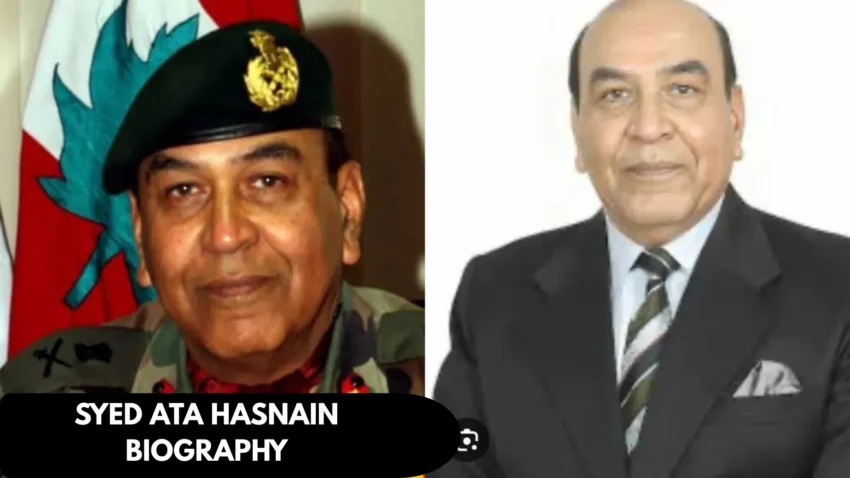
Syed Ata Hasnain is a distinguished retired Lieutenant General of the Indian Army, widely recognized for his leadership in counterinsurgency operations, strategic thinking, and contributions to national security discourse.
Over a military career spanning nearly four decades, he served in some of the most challenging operational environments, including Kashmir, the Siachen Glacier, Sri Lanka, and United Nations peacekeeping missions.
Beyond his military service, Hasnain has become an influential strategic analyst, writer, and academic contributor, participating in global discussions on geopolitics, terrorism, and security strategy.
His innovative approach to conflict management—particularly his “Hearts Doctrine” of people-centric counterinsurgency—has been widely studied in military and academic circles.
Early Life
Syed Ata Hasnain was born in 1953 in Uttar Pradesh, India into a military family. His father, Major General Syed Mahdi Hasnain, served in the Indian Army and commanded the Garhwal Rifles.
Growing up in a disciplined military environment played a major role in shaping his values of patriotism, service, and leadership. The Hasnain family is notable for its strong military tradition, with both father and son earning prestigious honors during their service.
From an early age, Ata Hasnain developed a strong interest in history, strategy, and global affairs—interests that would later influence his academic pursuits and professional career.
Education
Syed Ata Hasnain received a strong academic foundation from prestigious institutions in India and abroad.
Early Education
He studied at Sherwood College in Nainital, a well-known boarding school recognized for producing leaders in various fields.
University Education
After completing school, Hasnain attended St. Stephen’s College in Delhi, where he earned a Bachelor’s degree in History.
Advanced Studies
Throughout his career, he pursued higher education and strategic studies, including:
- MA in International Studies – King’s College London
- MPhil in Defence and Management Studies – Indore University
- MSc in Defence Studies – Chennai University
- Strategic programs at Royal College of Defence Studies (London)
- Security studies training at the Asia Pacific Center for Security Studies (Hawaii)
This combination of academic scholarship and military training helped shape him into what he calls a “Scholar-Warrior,” an officer who combines battlefield experience with intellectual insight.
Military Career
Commission into the Indian Army
Syed Ata Hasnain was commissioned into the 4th Battalion of the Garhwal Rifles on 16 June 1974 after graduating from the Indian Military Academy in Dehradun.
Interestingly, this battalion was originally raised by his father, making his commission into the same unit a proud family tradition.
Early Operational Experience
During the early years of his career, Hasnain served in multiple operational zones across India and abroad. His assignments exposed him to complex conflict situations and strategic challenges.
Some of his early deployments included:
- Counterinsurgency operations in Punjab
- Military operations in Northeast India
- Service in Siachen Glacier, the world’s highest battlefield
- Participation in Operation Pawan in Sri Lanka (1988–1990)
These experiences helped him develop expertise in high-altitude warfare, counterterrorism, and conflict management.
United Nations Peacekeeping Missions
Hasnain also served in United Nations peacekeeping missions in Mozambique and Rwanda during the 1990s.
These missions exposed him to international conflict resolution efforts and humanitarian operations. His service during these missions earned him his first major military decoration for distinguished service.
Key Leadership Roles
Over the course of his career, Hasnain held numerous high-ranking command positions, including:
- Commander of 12 Infantry Brigade along the Line of Control
- General Officer Commanding 19 Infantry Division in Baramulla
- Commander of 21 Strike Corps
- General Officer Commanding XV Corps (Chinar Corps) in Srinagar
- Military Secretary at Indian Army Headquarters in New Delhi
His command of the XV Corps, responsible for security in the Kashmir Valley, was particularly significant.
Command of XV Corps and the “Hearts Doctrine”
Between 2010 and 2012, Syed Ata Hasnain commanded the XV Corps, one of the Indian Army’s most strategically important formations operating in Kashmir.
During this time, he introduced a people-centric counterinsurgency strategy known as the “Hearts Doctrine.”
Core Principles of the Strategy
The doctrine emphasized:
- Building trust with local communities
- Improving civil-military relations
- Promoting dialogue and engagement
- Reducing hostility between civilians and the armed forces
This approach helped reduce tensions and improve cooperation between civilians and security forces in the region.
Many analysts credit his leadership with helping stabilize the Kashmir Valley during periods of unrest.
Military Awards and Decorations
Throughout his career, Lt. Gen. Syed Ata Hasnain received numerous military honors for his exceptional service.
Some of his most notable awards include:
- Param Vishisht Seva Medal (PVSM)
- Uttam Yudh Seva Medal (UYSM)
- Ati Vishisht Seva Medal (AVSM)
- Sena Medal (SM)
- Vishisht Seva Medal (VSM)
These decorations are among the highest honors awarded to Indian military officers.
Post-Retirement Career
Syed Ata Hasnain retired from the Indian Army in July 2013 after completing about 40 years of service.
After retirement, he remained active in academia, policy research, and public discourse.
Academic and Institutional Roles
Some of his key roles include:
- Chancellor of the Central University of Kashmir (appointed in 2018)
- Visiting Fellow at Vivekananda International Foundation
- Senior Fellow at Delhi Policy Group
- Contributor to major newspapers and policy journals
He frequently writes and speaks about:
- South Asian geopolitics
- India-Pakistan relations
- terrorism and extremism
- national security strategy
Leadership Philosophy
Syed Ata Hasnain is known for advocating a leadership model that balances military strength with empathy and communication.
Key Leadership Principles
1. People-Centric Security
He believes that sustainable peace requires winning the trust of local communities.
2. Ethical Leadership
He emphasizes integrity, discipline, and professionalism within the armed forces.
3. Scholar-Warrior Concept
Hasnain encourages military officers to develop intellectual depth alongside operational expertise.
4. Strategic Communication
He stresses the importance of counter-narratives and communication in modern conflict environments.
Personal Life
Despite a demanding military career, Hasnain has maintained a strong family life. He is married to Sabiha Hasnain, a corporate professional, and they have two daughters.
Outside his professional responsibilities, he enjoys traveling, trekking, and engaging with students and young professionals.
FAQs
Who is Syed Ata Hasnain?
Syed Ata Hasnain is a retired Lieutenant General of the Indian Army known for his leadership in counterinsurgency operations and strategic security analysis.
When was Syed Ata Hasnain born?
He was born in 1953 in Uttar Pradesh, India.
What is Syed Ata Hasnain famous for?
He is best known for commanding the XV Corps in Kashmir and implementing a people-centric counterinsurgency strategy called the “Hearts Doctrine.”
What awards has he received?
He has received several prestigious military honors including PVSM, UYSM, AVSM, SM, and VSM for distinguished service.
What does he do after retirement?
After retirement, he became a strategic analyst, academic contributor, public speaker, and Chancellor of the Central University of Kashmir.
Conclusion
Syed Ata Hasnain stands as one of the most respected military leaders and strategic thinkers in modern India. His four decades of service in the Indian Army, including leadership in some of the most challenging conflict zones, demonstrate his dedication to national security and professional excellence.
From commanding troops in Kashmir to shaping strategic debates on terrorism and geopolitics, Hasnain’s influence continues long after his retirement. His people-centric approach to counterinsurgency and commitment to intellectual leadership have made him a unique figure in the world of military strategy.
Today, as a writer, scholar, and mentor, Syed Ata Hasnain continues to contribute to discussions on global security, inspiring future generations of leaders and policymakers.